
Pro Ecclesia 2027 Conference
Save the date!
Pro Ecclesia 2027
January 11-13, 2027
Birmingham, Alabama
We're excited to announce that the date is set for our Pro Ecclesia 2027 conference: January 11-13 in Birmingham, Alabama. Our outstanding line of speakers includes:
Professor Eric Gregory of Princeton University
Professor Athanasios Papathahasiou of the University Supreme Ecclesiastical Academy of Athens
Professor Daniel Hill of Baylor University
Professor Sarah Gustafson of The Catholic University of America
Professor Fritz Bauerschmidt of Loyola University
Professor George Demacopoulos of Fordham University
Russell Moore of Christianity Today
Keep an eye out for more information and registration details, coming soon.
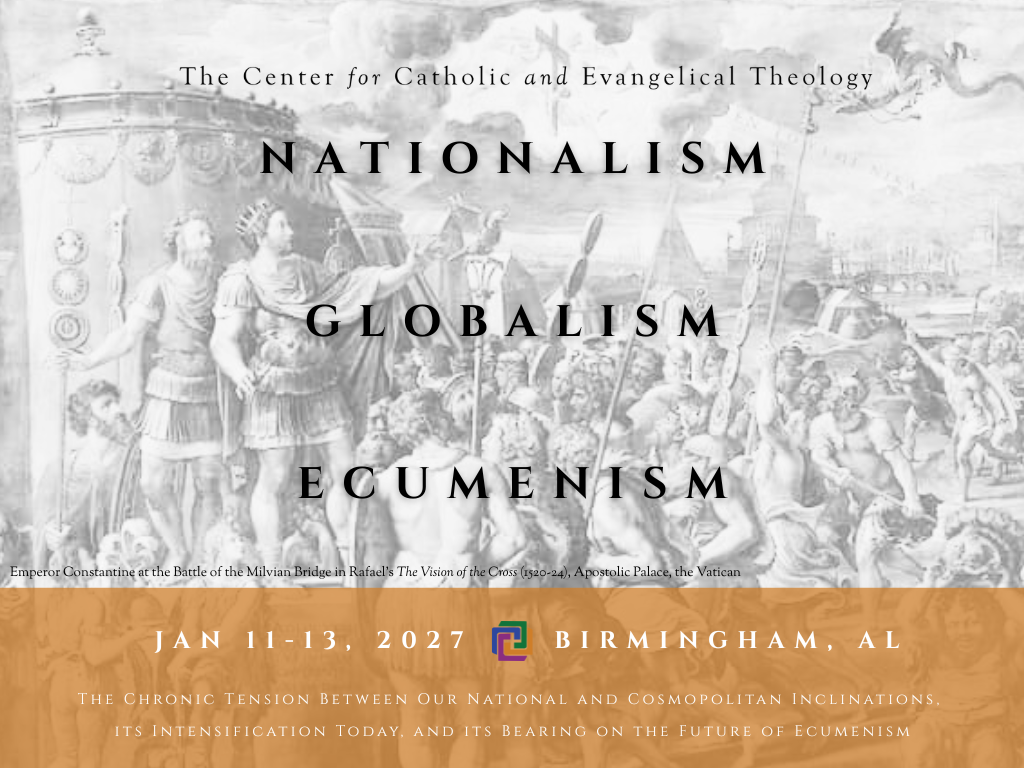
Nationalism, Globalism, Ecumenism:
The Chronic Tension between Our National and Cosmopolitan Inclinations,
Its Intensification Today, and Its Bearing on the Future of Ecumenism
Since the time of the New Testament, ethnic and national differences within the Christian church
have enriched our life together and yielded controversy as well. The apostles debated the
matter of Gentile inclusion within the family of God. Church fathers wrestled with a wide array of
issues that attended the Christianization of the ancient Roman Empire and its bearing on
relationships with Christians on its margins and concerned about the methods of imperial
Christianity. Medievals fought hard to build a Holy Roman Empire and include ever more tribal
groups within its ranks. The Orthodox have sought to spread a universal faith that respects the
autocephaly of largely national churches. Protestants like Luther appealed to German ethnicity
and national prerogatives when criticizing the methods of what they called the Roman Church.
Modern missionaries have sought to strike a balance in their work between indigenizing the faith
in newly Christianized regions and including new Christians in the holy catholic church. This list
of examples could go on for quite a while.
Our twenty-first century world has seen a surge in such tensions. Some Christians today have
embraced Christian nationalism, often in the name of Christian cultural conservatism. Others
protest that more international instincts must govern our attempts to demonstrate catholicity. As
this disagreement has festered, the ecumenical work of our churches has flagged.
What are we to make of this? How have these tensions shaped the ecumenical efforts of
believers in the past? And what can we learn from this? How should they inform our ecumenism
today? Come and join the conversation as we work on these questions in the service of the
church and seek to manifest the unity we share in Jesus Christ.